Personal repertoires
A person’s languages can cross family and community lines. Ethnic identity alone cannot tell us what someone speaks.
Қазақстан
A multilingual country.
A language landscape in motion.
Kazakh, Russian and community languages connect homes, classrooms and public life in different ways.
Meet the Kazakh language →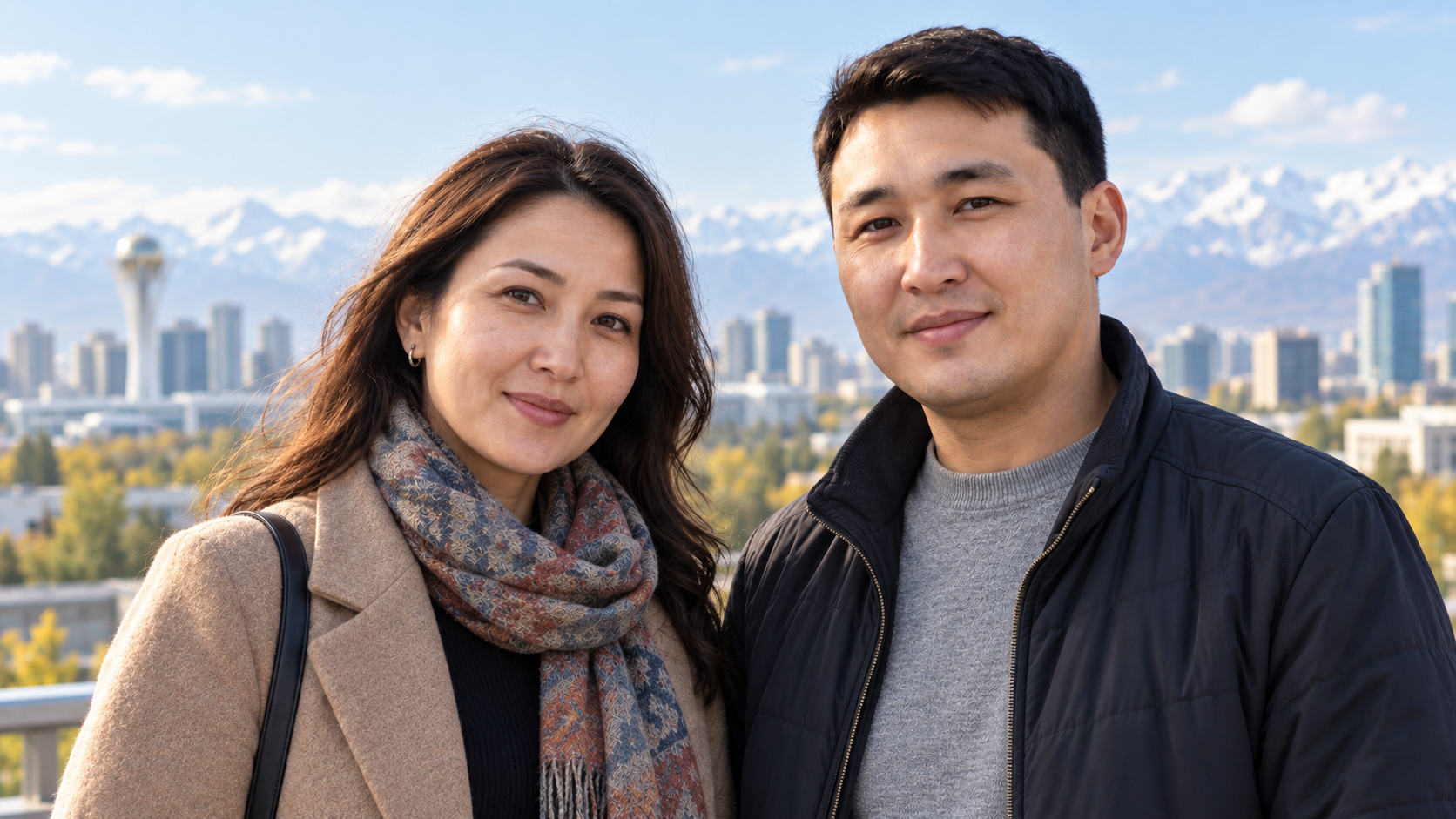
Kazakh is the state language. Russian has an official-use role and remains widely used. These descriptions do not mean that every resident speaks both.
Current constitutional wording is awaiting primary-source review. This prototype does not quote the former Article 7 as current law. Read the research note ↗
Community languages include Uzbek, Uyghur, Tatar, German, Korean and others. Identity, home language and language ability are different measures. ↗ source
Population aged 5 and over. People may report more than one language; percentages do not sum to 100%. Not a fluency test, native-speaker count or 2026 estimate. Census, pp. 292 & 323 ↗
Explore geographic context without drawing artificial boundaries between speakers.
Kazakhstan lies south of Russia and west of China. It also borders Kyrgyzstan, Uzbekistan and Turkmenistan.
The highlighted area locates the country within its region. It makes no claim about the languages spoken by any person or community.
Geographic context, not a language boundary. Map geometry: Natural Earth.
Kazakh has been written in Arabic, Latin and Cyrillic scripts. Each change belongs to a particular historical and political context.
◐ In MotionA Cyrillic-based alphabet became established in Soviet Kazakhstan in 1940 and remains central to Kazakh publishing and daily writing. A planned script change is not the same as a completed transition.
Timeline refers to Kazakhstan; Kazakh communities elsewhere have different script histories. Sources & qualifications ↗
A person’s languages can cross family and community lines. Ethnic identity alone cannot tell us what someone speaks.
Kazakh and Russian appear across public communication and business. Their use varies by setting and by the people involved.
Census responses vary by age. English learning adds another layer, without replacing the country’s other languages.
A general overview, not a prediction about an individual or a locality. Everyday use ↗ · Census age tables ↗
Arabic-based writing connects Kazakh to earlier literary and educational traditions.
Latin and then Cyrillic reforms changed how Kazakh was written; Russian became deeply embedded in public life.
The Latin-alphabet initiative raises practical questions about learning, publishing and access to older texts.
Writing-system history ↗ · Language landscape ↗
Follow the language beyond the country.
Research checked 20 September 2026. The portrait alone is human-approved. Legal wording, current Latin rollout and specialist language review remain open.
Language proficiency: pp. 292, 323, 356–360. Figures describe census responses, not tested fluency or exclusive language groups.
Open original source ↗Language identity, classification and linguistic bibliography.
Open original source ↗Autonym, script samples, pronunciation and writing-system history. Forward-looking rollout dates are not treated as proof of implementation.
Open original source ↗Community languages and everyday use. Census values were checked against the original statistical publication.
Open original source ↗Grammar, geographic presence and related languages. Speaker estimates are omitted because dates and definitions differ.
Open original source ↗Research indicates a 2026 constitutional change. The official English constitution link redirected to the presidential homepage; no obsolete article is presented as current law.
Open original source ↗1:110m country geometry. Generalized geographic context only; it does not map individual speakers or language boundaries.
Open original source ↗